
Cameras
The invention that has intrigued me most is the camera. To this day, I do not understand how it works, but I think it is a magical invention. Things are out there—in space, on the street, or in the house—and by pushing a button on a once rather bulky, now svelte black or silver box, that thing can be transferred onto a piece of paper or computer screen. Tooth fairies and superheroes may be stretches of the imagination, but a camera with its diverse lenses seems to be the ultimate miracle. I once met the remarkable photographer, essayist, and teacher Susan Sontag, who explained that photography is as much about the person taking the picture as the picture itself. A photograph depends not so much on the thing out there, but rather on the person holding the camera, the spot where he or she is standing, and the angle from which he or she is shooting. The educationist Parker Palmer has said,
We cannot see what is out there by simply looking around. Everything depends on the lenses through which we see the world. By putting on new lenses, we see things that otherwise would be invisible.1
Narratives,...
Read More
Cameras
The invention that has intrigued me most is the camera. To this day, I do not understand how it works, but I think it is a magical invention. Things are out there—in space, on the street, or in the house—and by pushing a button on a once rather bulky, now svelte black or silver box, that thing can be transferred onto a piece of paper or computer screen. Tooth fairies and superheroes may be stretches of the imagination, but a camera with its diverse lenses seems to be the ultimate miracle. I once met the remarkable photographer, essayist, and teacher Susan Sontag, who explained that photography is as much about the person taking the picture as the picture itself. A photograph depends not so much on the thing out there, but rather on the person holding the camera, the spot where he or she is standing, and the angle from which he or she is shooting. The educationist Parker Palmer has said,
We cannot see what is out there by simply looking around. Everything depends on the lenses through which we see the world. By putting on new lenses, we see things that otherwise would be invisible.1
Narratives, Lenses, and Israel Education
The lenses paradigm is related to what is today popularly called narratives. Narratives are ways of looking at the world, and according to this approach, in education we don’t teach facts, knowledge, history, or geography, but rather diverse versions (narratives) of how facts, history, or geography happen. Narratives are not falsehoods; they are rooted in empirical facts, observation, and reflective research by scholars, and are organized and presented to help us find meaning in our past and present. There are few subjects that are more camera and narrative related than Israel. There are few ideas, sites, and things that invite more diverse photographs than Israel. One photographer could take a picture of the Western Wall in Jerusalem and have the image emerge as an other-worldly journey in spirituality. Another person, standing at a different spot, could produce a snapshot of elderly men in garb from several prior centuries, mumbling strange incantations—with nary a woman in sight—and have it emerge as an outdated relic of a yesteryear religion. Still another could take a photograph and have it not at all relate to the Western Wall of the Jews, but rather focus on the mosques of the Temple Mount.
Five Views of the Western Wall
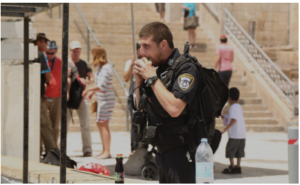
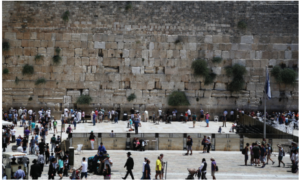
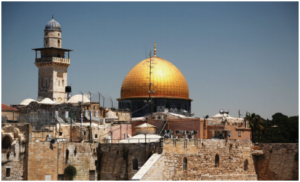
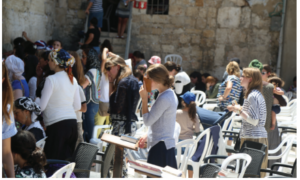
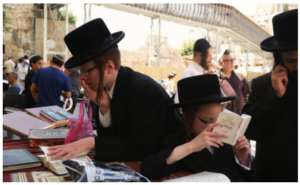
The camera story and the narrative theory are critical for Israel education. There are diverse narratives about the Zionist movement, the establishment of Israel, and contemporary Israel. The most dramatic conflicting narrative versions are clearly between Israel and her neighbors, but within the Jewish world too there are conflicting narratives. Recall the Western Wall vignettes? The pictures just described were taken by people who see the Wall in dramatically different ways.
Israel today lends itself to diverse vantage points, perspectives, and tellings of the story. Indeed, the diverse pictures of Israel are in some ways the essence of life in Israel. The richness of Israel is that everyone is a narrator and everyone is a photographer. We have three tasks concerning lenses and narratives in Israel education.
Our first task is to help our youth learn prominent narratives that Jewish history and life have promulgated and accepted—rooted in both objective realities and research by historians. Our second task is (over time) to teach that one wonderful aspect of Jewish life has been its openness to diverse narrations and narrators; that Jewish life values a tradition of commentary, debate, and discourse which, when effected properly, is regarded as in the name of Heaven (Shem Shamayim), i.e. a praiseworthy activity. Our third task is to help our youth become narrators and photographers on their own—to give them the tools to see alternative pictures and hear diverse narratives and hopefully, through their own pictures and stories, to understand a Jewish narrative that speaks to them.
Teaching Prominent Israel Narratives
There are several prominent Israel narratives which our youth should have the opportunity to hear and learn from in their formative years. Understanding these narratives during their early years will enable our youth to deal with conflicting narratives as they grow older. If they do not begin with these diverse narratives as part of their youthful legacy, it will be difficult for them to intelligently deal with complex narratives as young adults. The teaching of these narratives should reflect the best of Jewish scholarship and research. It should be based as much as possible on primary Jewish sources, and it should be pedagogically accessible and interesting.
Birthplace and Covenant
One of the prominent understandings of Israel is that it is the birthplace and sign of the Covenant between G-d and the Jewish people. According to this narrative, the Jews as a people originated in the ancient Land of Israel; its early history is almost exclusively related to Israel; and the evolution of its core heroes and values is in Eretz Yisrael. The sagas of the Patriarchs, the Exodus from Egypt, the vision of the Prophets and their religious-ethical creeds, the monarchies, and the Temple culture are all Eretz Yisrael-based. This entire narrative is wrapped in a grand narrative often denoted as the Covenental relationship (see “Eretz, Medina, Am Yisrael: Navigating Multiple Landsapes”). This narrative is best studied with original Biblical texts such as Genesis 17:8, Genesis 35:12, Exodus 20:12, Amos 9:14- 15, Psalm 137: 5-6, and others.
Memory and Hope
This narrative reflects the transformation of a land- and cult-centered Israelite religion into rabbinic Judaism. It is the remarkable saga of Jewish teachers and leaders over the ages and across diverse lands who transformed a cultic-national based people into the Jewish religion. In this narrative, Jews became part of a religious community existing, in varying degrees of accommodation, in diverse host countries while preserving core values, behaviors, and texts of former days. Central to this story is the ongoing remembrance and longing to return to Zion. While out of Israel, the Jewish people used ritual (breaking a glass at weddings, using the words “next year in Jerusalem” at the end of the Passover Seder), prayer, poetry (such as works by Yehuda Halevi), and law (diverse rabbinic and Talmudic statements) to keep Eretz Yisrael and the value of Shivat Zion (returning to Zion) as lynchpins of Jewish existence. Key documents that explicate this vision are Talmudic and rabbinic literature, the prayer book, and literary and philosophic writings (e.g. Babylonian Talmud, Ketubot 110b, and Baba Batra 60b and 158b, Vayikra Rabba 34:7, Midrash Tehillim 105:1, Rashi on Genesis 1:1, the Shema, the Amidah, and Birkat HaMazon in the siddur). Many of these sources are collected in the Tuvia Book For the Sake of Zion: Pride and Strength through Knowledge: An Educator’s Guide.2
Returning To Zion (Shivat Zion)
This narrative reflects a shift from references to Jewish as the religion to 1) the Jewish people’s confrontation with modern societies and to 2) the emergence of a modern movement advocating for the physical return of the Jewish people to their homeland. The pre-Zionists (Hess, Kalischer) and the Zionists (Herzl, Ben-Gurion, Jabotinsky, A.D. Gordon, and Rav Kook) weaved a narrative that proposed that Jews could only find haven, creativity, sustainability, and dignity by physically returning to their ancestral homeland. The phrase was always to return and the methods were political, economic, and practical. This movement regarded the Jewish people not as a group of outsiders invading foreign territory, but as an indigenous people returning to their original home. The pinnacle of this narrative is the establishment of a Jewish State, recognized by the world community in May 1948 and a vibrant statement of this narrative is the Israeli Declaration of Independence (Megillat Ha’atzmaut). This document is a rich resource that encompasses values, history, sociology, and contemporary Realpolitik. The original writings of Zionist thinkers such as Hess, Pinsker, Herzl, Achad Ha’am, Bialik, A.D. Gordon, Ben-Gurion, Weizmann, and Jabotinsky are also useful texts for exploration of this narrative.3
The State of Israel
The fourth narrative is the story of a modern Jewish state and contemporary society for millions of Jews from all over the world (as well as several minority populations), living in a neighborhood of ongoing conflict. This narrative unfolds in art, music, industry, pop culture, government, politics, education, and all those elements which comprise modern societies. It is about many achievements and many challenges. Can the state be Jewish, but also general? Can it be both modern and traditional? Can it be Jewish, but also inclusive of non-Jewish citizens? Can it be Ashkenazi and Sepharadi? Is it a Jewish state or a state of Jews? Can it just be? This narrative is a love story, an adventure story, a drama, a comedy, and at moments a tragedy. It is a story new to the Jewish experience and as such is characterized by all the excitement and complexity of new ventures and experiences.
Tools for understanding:
- Give our youth “the tools to see alternative pictures and hear diverse narratives and…to understand a Jewish narrative that speaks to them.”
- Begin the educational process “in the early years through high school so that by young adulthood, our youth are well-equipped photographers on their own.”
The best text for this narrative is clearly the visit to Israel. The more than half-million youth between the ages of 13 and 26 who have visited Israel since statehood and have experienced the narrative and photographed it with their own eyes bear testimony to the richness of this text. Unfortunately, this number constitutes a minority of world Jewry. In lieu of the visit—or in preparation for it—the task of Israel education is to create dynamic, engaging resources which make contemporary Israel come alive. In this context, it is useful to coopt Howard Gardner’s notion of multiple intelligences and to suggest that a diversity of cameras should be used to capture the State of Israel. Some youth will be ignited by music and others by literature; some by architecture and others by food; some by heroes and others by events; some by politics and others by people. Beyond the trip—which is unquestionably the pedagogic technique par excellence—a host of diverse resources now exist or can be created.
The Peoplehood of Israel (Klal Yisrael)
This narrative views the Jews as a world-wide collective living among the nations of the world with a special center called the State of Israel. This narrative is eloquently described in the writings of Achad Ha’am and Mordechai Kaplan which regard the existence of a Jewish state as a central force in the artistic, cultural, intellectual, and interpersonal blossoming of the Jewish people. This narrative focuses on the state as an instrument and catalyst of spiritual, artistic, cultural, and intellectual Jewish creativity and longevity. At the same time it raises issues of the relationship of Jews outside of Israel to the indigenous population. Are Jews not living in Israel in Exile, ‘Diaspora,’ Galut, Gola, or are they equal citizens of the State of the Jewish People? What is the connection of Jews worldwide to Israeli life, politics, culture, and policy-making? Can there be global partnership without mutual responsibility? The texts of this narrative are being written everyday and even as we write and read this anthology. They are in novels, poems, academic writings, political activism, lobbies, and national and international Jewish organizational life in Tel Aviv, Jerusalem, New York, Ottawa, London, Buenos Aires, and Lima.
Alternative Narratives
The narratives sketched here are not the only Israeli narratives. As noted, there are several alternative non-Jewish narratives of Israel, e.g., Christian, Muslim, and Palestinian. Because of its unique location at the physical and theological crossroads of history, the Land of Israel has been shaping significant narratives for other religions and peoples and indeed for world history.4 The fact of these diverse narratives is an existential reality of the State of Israel and contemporary life. Our goal is not to resolve these complicated dilemmas, but neither are we free to desist from engaging with them in our educational work. Diverse non-Jewish Israel narratives must be taught and they should not be a priori discarded because they are the other.
The existence of these non-Jewish narratives should be referenced both for comparative purposes and also to introduce the idea of other narratives to our youth at an early age rather than waiting until they are rudely made aware of their existence in their college years. At the same time, the existence of diverse narratives should not lead to the conclusion that narratives are simply emotive expressions of personal religious or political loyalty, but rather that there are reasons, understandings, and explanations behind these diverse narratives. The coexistence of diverse narratives does not mean that all narratives are the same or equally coherent. The ability to critically judge diverse narratives with the skill sets defined as cognitive emotions is an important part of Israel education.
The idea of different perspectives is not foreign to children—even young children. They grow up in a multicultural, multi-religion, multi-national world. They know from an early age that there are different ways of being Jewish, and they know that there are different cultures, political parties, and sports teams. We do ourselves a disservice by not indicating that there are other perspectives to Israel: youth often feel cheated or deceived when they learn about them in their later years. Again, it is not our job to engage in a full-fledged comparative political science seminar in conflicting narratives. We have a narrative that we accept as reasonable, compelling, and legitimate; it is our role to present it in an open and engaging way. In teaching the core narratives, we have a unique opportunity to teach something important both about Judaism and about critical thinking. Judaism is a religion, culture, and civilization that has encompassed and encouraged diverse views on many matters. It is a culture that, on the whole, has encouraged critical thinking and discussion. Critical thinking is not a skill reserved for math, science, and general studies. Our ancestors were among the creators of critical thinking.
It is important that Israel educators be comfortable in their own skin with the notion of multiple prominent Israeli narratives. Like all narratives, parts are very convincing and compelling, and others make us uncomfortable (the American narrative too encompasses both grand and problematic chapters). Belief in the grandeur of the Bible does not mitigate some difficult passages for us and for the rabbis throughout the ages. As our youth approach adolescence and young adulthood, we should be teaching them how to become photographers and narrators. We should be transmitting to them the critical, analytic, and reflective skills to read, discuss, debate, and consider alternative narratives so that, ultimately, they have the ability to create their own narrative.
Further Reading
Hoffman, Lawrence A., ed. The Land of Israel: Jewish Perspectives. Notre Dame, Indiana: Notre Dame University Press. 1986. Print.
Photo credit: Shmulik Belo
Endnotes
1 Palmer, Parker J. The Courage to Teach: Exploring the Inner Landscape of a Teacher’s Life. San Francisco, Jossey-Bass: 2007. 27. Print.
2 Book, Tuvia. For The Sake of Zion: Pride and Strength through Knowledge: An Educator’s Guide. New York: BJE of New York, 2004. Print.
3 Hertzberg, Arthur, ed. The Zionist Idea. New York: Atheneum, 1982. Print.
4 Armstrong, Karen. Jerusalem: One City, Three Faiths. Ballantine Books, 1997. Print.
Barry Chazan is Professor of Education Emeritus at the Hebrew University of Jerusalem and Professor of Education at the Spertus Institute of Jewish Learning and Leadership. He is founding Director of Education of Birthright Israel and author of books and articles on moral education, informal education, and Israel education.